Tag Archives: corporate power

Podcast

Ida Susser on the Yellow Vests, Abdul El-Sayed on Medicare for All

Writer’s Voice: compelling conversations with authors who challenge, inspire, and inform.

What does it take to win back a democracy, and who is our government really supposed to serve?

This week on Writer’s Voice, I talk with anthropologist Ida Susser about her book, The Yellow Vests and the Battle for Democracy. She tells the story of a movement in France that began with anger over a diesel tax and grew into a much deeper defense of public services, economic dignity, and democratic power.

“There is no other thing to do for democracy, but fight for your rights every single way and day that you can.” – Ida Susser


Then, following Abdul El Sayed’s victory in Michigan’s Democratic primary for the U.S. Senate, we return to my 2021 conversation with him about the book he co-wrote, Medicare for All: A Citizen’s Guide. El-Sayed explains why American healthcare costs so much, how private insurance drives those costs higher, and how Medicare for All could cover everyone while giving the public real power over prices.

“Under Medicare for All, we would pay for the system far more progressively to cover everyone.” – Dr. Abdul El Sayed

Two movements, one fundamental question, can ordinary people reclaim the institutions meant to serve them?

Follow us on Bluesky @writersvoice.bsky.social and subscribe to our Substack. Or find us on Instagram @WritersVoicePodcast.

Love good coffee? Want to support Writer’s Voice? Head on over to Larry’s Coffee using this LINK, and you’ll earn $30 for the show!

You may also like: Abdul El Sayed & Micah Johnson, MEDICARE FOR ALL: A Citizen’s Guide, Remembering The Revolutions of 2011

Tags: Ida Susser, Abdul El-Sayed, Yellow Vests, Medicare for All, Michigan Senate primary, democracy, healthcare reform, single-payer healthcare, neoliberalism, social movements, corporate power, Writer’s Voice

Read the Transcript

Continue reading

Podcast

Can Sci-Fi Save Us? John Feffer on SONGLANDS and Portia Elan on HOMEBOUND

Writer’s Voice: compelling conversations with authors who challenge, inspire, and inform.

Can science fiction help us imagine a way through climate crisis, runaway corporate power, and the rise of AI?

This week, we talk with John Feffer about Songlands and Portia Elan about Homebound, two speculative novels that ask how we can make a livable future in an age of crisis.

Songlands, the final novel in Feffer’s Splinterlands trilogy, takes us into a climate-ravaged world where nations have fractured and a biotech corporation holds enormous power. Yet poetry, collective action, and a conscious, caring AI offer another way forward.

“Love is an important kind of operating system, if you will, to define one’s relations with the world.” — John Feffer

Portia Elan’s Homebound travels across 600 years, connecting a queer coder in 1985 with a smuggler in 2585. Their stories come together through grief, a mysterious video game, found family, and the moral choices that shape history.

“[AI] is a reflection of the values of the creators. I’m afraid of the human choices, not so much of the LLM choices.” — Portia Elan

Follow us on Bluesky @writersvoice.bsky.social and subscribe to our Substack. Or find us on Instagram @WritersVoicePodcast.

Love good coffee? Want to support Writer’s Voice? Head on over to Larry’s Coffee using this LINK, and you’ll earn $30 for the show!

[Episode 1036]

Read The Transcript

Continue reading

Podcast

Noam Scheiber on the Mutiny of the New Working Class

Writer’s Voice: compelling conversations with authors who challenge, inspire, and inform.

Economic insecurity is reshaping America’s workforce. Will that bring college-educated and non-college educated workers together?

For decades, Americans were told that education was the pathway to the middle class. Get a degree, work hard, and professional success would follow. But that promise has weakened.

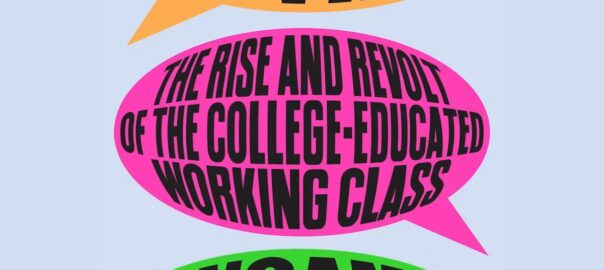
In Mutiny: The Rise and Revolt of the College-Educated Working Class, New York Times reporter Noam Scheiber argues that millions of college graduates increasingly face the same insecurity that has long confronted blue-collar workers. They carry heavy student debt, struggle to find stable careers, and often discover that professional jobs offer less autonomy and dignity than previous generations enjoyed.

Writer’s Voice talks with Scheiber about the organizing drives at Starbucks, Apple, Amazon, and among Hollywood writers, along with the changing realities facing doctors, graduate students, and other professionals. He explains why so many workers who once imagined themselves as future managers or professionals are instead embracing unions and collective action.

The conversation explores how corporate restructuring, the aftermath of the Great Recession, streaming media, and artificial intelligence are reshaping work across industries. Scheiber argues that the traditional divide between college-educated and non-college-educated workers is narrowing as economic precarity spreads throughout the labor force.

The result, he suggests, may be a new politics of work, one in which people who once saw themselves as members of different social classes increasingly recognize common interests.

Follow us on Bluesky @writersvoice.bsky.social and subscribe to our Substack. Or find us on Instagram @WritersVoicePodcast.

Love good coffee? Want to support Writer’s Voice? Head on over to Larry’s Coffee using this LINK, and you’ll earn $30 for the show!

Tags: Noam Scheiber, Mutiny, Starbucks Workers United, Amazon Labor Union, Apple union, Hollywood writers strike, college graduates, economic inequality, AI and work, worker organizing, precarity, corporate power, Writer’s Voice podcast

You might also like: Maria Adelmann on Adjunct Labor, Cory Doctorow on Big Tech’s “Enshittification”

Read the Transcript

Continue reading