
Podcast: Play in new window | Download
Subscribe: Apple Podcasts | RSS
Writer’s Voice: compelling conversations with authors who challenge, inspire, and inform.
Episode Summary
What if the story we tell about civilization is wrong?
What if human history isn’t a steady march from “primitive” hunter-gatherers to ever more advanced societies, but something far messier, more inventive, and more fragile — a long experiment of adaptation, collapse, reinvention, and survival?
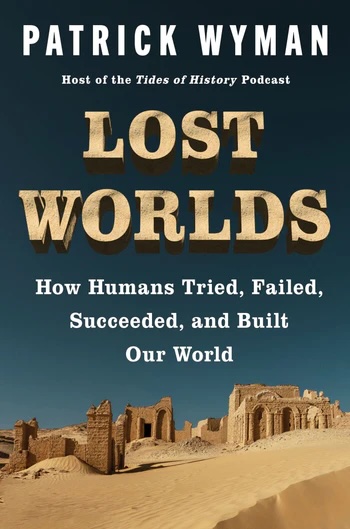
Our guest, historian and podcaster Patrick Wyman takes readers deep into that story in his new book, Lost Worlds: How Humans Tried, Failed, Succeeded, and Built Our World.
“Our human past is infinitely bigger than we generally tend to think it is.”
Drawing on breakthroughs in archaeology, ancient DNA, isotope analysis, and climate science, Wyman takes us from Ice Age North America to Bronze Age cities and forgotten civilizations across Europe and the Mediterranean. Along the way, he challenges the idea that history follows a single path toward “civilization.” Instead, he reveals a human story filled with experimentation, adaptation, migration, collapse, and renewal.
At a moment when many people feel trapped by crises that seem beyond our control, Lost Worlds offers a powerful reminder that history is full of alternatives, and that the future remains unwritten. One thing is clear: we’ve always had more choices than we thought.
Follow us on Bluesky @writersvoice.bsky.social and subscribe to our Substack. Or find us on Instagram @WritersVoicePodcast.
Tags: Patrick Wyman, Lost Worlds, Bronze Age collapse, Göbekli Tepe, Trypillia, Mycenaean Greece, Sea Peoples, hunter-gatherers, ancient DNA, archaeology, migration history, collapse and renewal, human prehistory, Writer’s Voice podcast,
You Might Also Like: David Wengrow, THE DAWN OF EVERYTHING, Lizzie Wade on APOCALYPSE: What Collapse Reveals About Human Possibility
Patrick Wyman, LOST WORLDS
Segment Summary
The scale of the human past — Wyman opens by making the case that even people who love history dramatically underestimate how much of it there is, how many societies have existed, and how different they were from each other and from our assumptions.
Why civilization didn’t unfold in a straight line — Agriculture was independently invented multiple times, in places that look nothing like each other. The “package” of traits we associate with civilization — farming, cities, hierarchy, writing — didn’t arrive together, and they weren’t inevitable.
Migration as humanity’s oldest survival tool — Wyman pushes back on the idea that people are supposed to be rooted in place. Over long periods of time, moving is the baseline human response to pressure, and new tools like ancient DNA are letting us see those movements more clearly than ever before.
New archaeology and what it reveals — The Kosice mass grave in Poland, the Anzick child burial in Montana, the antler frontlets at Starcar in England: Wyman shows how new scientific methods are turning what used to be anonymous fragments into intimate human stories.
Göbekli Tepe, Trypillia, and the problem with “civilization” — Wyman is skeptical of checklists that define which societies “count” as civilizations. He argues those checklists exclude extraordinary experiments in human organization, and he makes the case for taking the Trypillia megacities seriously on their own terms.
The Bronze Age collapse — Around 1200 BC, one of the most prosperous and interconnected worlds in ancient history fell apart in a cascading systems failure. Wyman argues the same interconnections that made it successful made it fragile — and draws explicit parallels to disruptions in global supply chains today.
Collapse and renewal — Wyman pushes back on apocalyptic collapse narratives. Even the worst collapses left survivors with knowledge, agency, and choices. The end is never the end.
About the Author
Patrick Wyman is the host of The Tides of History and The Fall of Rome podcasts, author of several books, and creator of the Substack Perspectives: Past, Present, and Future,