
Podcast: Play in new window | Download
Subscribe: Apple Podcasts | RSS
Writer’s Voice: compelling conversations with authors who challenge, inspire, and inform.
Resistance Is the Story
When we tell the history of slavery, too often we tell it as a story of suffering relieved by benevolent reformers. But what if resistance — not submission — was the central thread all along?
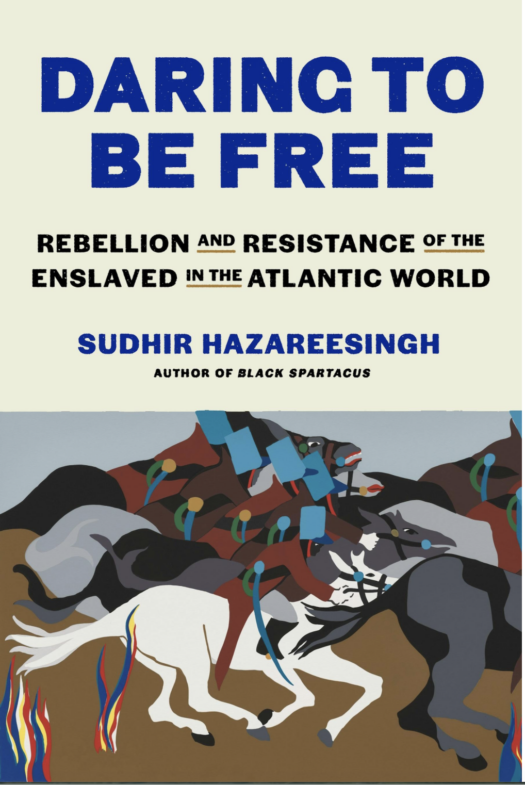
This week on Writer’s Voice, we begin with historian Sudhir Hazareesingh, whose groundbreaking book Daring to Be Free reframes the history of Atlantic slavery as a history of rebellion: from African defense militias and shipboard revolts to maroon communities and the Haitian Revolution. He restores enslaved women and men to the center of their own liberation struggles — not as passive victims, but as strategists, spiritual leaders, and revolutionaries.
“From the very moment slave raiding parties are sent out… people begin to resist.” — Sudhir Hazareesingh
Then we revisit my 2012 conversation with novelist Jacqueline Sheehan about The Comet’s Tale, her powerful work of historical fiction about Sojourner Truth. Through Truth’s childhood in bondage, her spiritual awakening, and her emergence as a fearless abolitionist and women’s rights advocate, we explore resilience, moral courage, and the making of a revolutionary life.
Follow us on Bluesky @writersvoice.bsky.social and subscribe to our Substack. Or find us on Instagram @WritersVoicePodcast.
Tags: Sudhir Hazareesingh, Daring to Be Free, Atlantic slavery, slave resistance, Haitian Revolution, Solitude of Guadeloupe, maroon communities, Sojourner Truth, Jacqueline Sheehan, The Comet’s Tale, Abolition movement, Black history, Writers Voice podcast,
You May Also Like: Aaron Robertson, THE BLACK UTOPIANS, Ben Passmore on Black Resistance
Read The Transcript
Segment One: Sudhir Hazareesingh
There are many histories of the Atlantic slave trade. Few center the enslaved as agents of their own freedom.
In Daring to Be Free, Sudhir Hazareesingh challenges the myth that resistance was rare or exceptional. Instead, he shows that resistance was woven into the fabric of slavery from the very beginning.
Solitude and the Erased Women of Resistance
Hazareesingh opens with the story of Solitude of Guadeloupe — a freedom fighter who resisted Napoleon’s 1802 attempt to reinstate slavery and was executed while remaining defiant . Her story, erased for generations, symbolizes what he calls a “hidden history” of resistance.
For too long, he argues, histories focused on male leaders and major revolutions, especially Haiti. But enslaved resistance was constant — and women were central actors: strategists, healers, organizers, spiritual leaders .
Resistance Began in Africa
Hazareesingh emphasizes that rebellion did not begin in the Americas. It began in Africa itself.
From the moment slave raiders entered African villages, communities organized militias, fought capture, resisted transport, and even planned revolts while confined on the coast .
Shipboard insurrections were often planned before captives even boarded the ships. Resistance was integral to the system — not an exception to it.
Spiritual Traditions as Sources of Power
African religious traditions — including Obeah and Islam — fortified resistance movements . These spiritual systems preserved identity, offered psychological protection, and helped organize rebellion.
Under conditions of near-total domination, enslaved people carved out autonomous interior worlds — sustaining languages, faiths, and networks of solidarity .
Women as Network Builders
Women, often working inside plantation households, gathered intelligence and helped coordinate revolts . They maintained kinship networks that countered what one historian called slavery’s “social death.”
Hazareesingh discovered instead a story of social persistence: communities forming bonds across plantations, across ethnic lines, and even across racial boundaries.
Palmares and Cross-Boundary Alliances
One astonishing example: Palmares in 17th-century Brazil — a vast maroon society of thousands that developed political systems, agriculture, trade, and military defenses .
Palmares blended African and Indigenous military traditions and even attracted poor whites seeking more humane community .
Resistance was multiracial, transnational, and sustained.
Haiti: Rank-and-File Revolution
While Hazareesingh has written on Toussaint L’Ouverture, in this book he emphasizes rank-and-file insurgents .
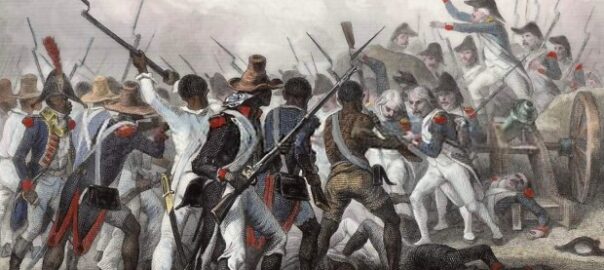
The Haitian Revolution became a beacon of Black sovereignty — and a terror to slaveholding powers . News of the uprising spread rapidly via sailors and refugee networks .
Yet Haiti paid a devastating price: punitive indemnities imposed by France in 1825, U.S. intervention under Woodrow Wilson, and ongoing destabilization .
The Enslaved as the True Abolitionists
Hazareesingh challenges the narrative that white reformers abolished slavery. Most abolitionists advocated gradualism. The enslaved demanded — and fought for — immediate freedom .
Their revolts and persistent pressure forced political change.
Honoring Our Debts
In concluding, Hazareesingh calls for a “debt of memory” — telling the story truthfully — and for serious engagement with material reparations .
And he offers a lesson for today: unity, resilience, and moral courage in the face of authoritarianism .
Segment Two: Jacqueline Sheehan
The Comet’s Tale — A Novel of Sojourner Truth
In our encore conversation from 2012, novelist Jacqueline Sheehan explores the inner life of Sojourner Truth.
Isabella’s Childhood in Bondage
Born Isabella Baumfree in Dutch New York, Sojourner Truth’s first language was Dutch .
Sheehan spent five years researching Truth’s early life, drawing from the dictated narrative recorded by Olive Gilbert in Massachusetts .
Her novel focuses intensely on childhood — the psychological resilience required to survive being treated as property and sold away from family .
The Power of Story
The title The Comet’s Tale comes from a fictionalized birth story told by Isabella’s mother — illustrating how oral tradition helped enslaved parents maintain connection with children sold away .
Storytelling becomes an act of survival.
Spiritual Seeking and Dangerous Faith
After gaining freedom, Isabella moved to New York City during a period of religious ferment .
She became involved in the cult of Matthias — a charismatic religious leader who manipulated followers and dictated their lives .
Later, after a profound spiritual epiphany, she renamed herself Sojourner Truth — believing God had called her to preach .
Though illiterate, she became a mesmerizing orator; newspaper accounts described the hair standing on listeners’ necks .
Florence, Massachusetts: Political Awakening
Truth eventually found community at the Northampton Association for Education and Industry — a utopian, abolitionist community based on equality of labor and one person, one vote .
There she interacted with Frederick Douglass and David Ruggles, and blended her spirituality with abolitionism and women’s rights activism .
She later supported Black soldiers during the Civil War and met Abraham Lincoln .
Resilience as Choice
Sheehan emphasizes Truth’s moral agency: despite enduring profound injustice, she chose not to live in hatred .
Her life illustrates that even under brutal conditions, individuals retain the capacity for courageous choice.